
Unit 5: Lesson Plan Structure
Lesson Plan Stages: Core
The course structure of every lesson will include:
- Warmer
- Presentation Section: Vocabulary u2013 7-10 words per one-hour class is standard
- Practice
- Production
- Wrap-up
Lesson Plan Details

Date/time u2013 This allows you to keep a historical record of what you have done with a class and when.
u00a0
Student level of proficiency u2013 The level of ability the class has with the English language.
u00a0
Number of studentsu00a0u2013 You should anticipate how many students will attend to make sure that your activities are suitable for the class size and that you have the required amount of resources and supplies.
u00a0
Age group u2013 The age range of the students who will be receiving the lesson.
u00a0
Lesson Type u2013 Speaking, Reading, or Listening. Despite the lesson type, you should try and incorporate all four necessary skills for language proficiency (speaking, reading, listening and writing).
u00a0
Topic u2013 The specific content that will be covered in the lesson.
u00a0
Theme u2013 The context in which the instructor will present the topic.
u00a0
Timetableu00a0u2013 It is vital to plan how long each activity is expected to take. You should then be able to see if you have too much content or not enough. u00a0Be realistic and flexible with your timing. u00a0If not, you will have to either make up for lost time or fill in extra time. u00a0This is one of the most difficult areas for inexperienced teachers. u00a0How long will it take your students to read a text? u00a0Only experience and a sound knowledge of your students will tell you this for sure. But for the purposes of this course, there are some standard timetable allocations that we will start with.
Teaching aimsu00a0u2013 This is what you want the students to be able to do by the end of the lesson. Be clear and concise about what information you want to convey for the lesson. Tell the students exactly what you want to achieve that day. For example: Today my aim is to make you confident in counting in Thai and bargaining on the price of something at the store.
u00a0
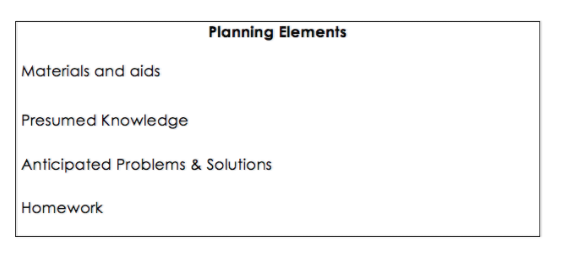
Materials and aidsu00a0u2013 This is materials and other aids (cassette player, etc.) that you will need in your lesson. u00a0This will help you quickly check if you have everything at the start of a lesson.
u00a0
Presumed knowledgeu00a0u2013 This is the material that you expect your students to know going into each dayu2019s lesson. For example, letu2019s say that you are teaching a speaking lesson on going to a restaurant and plan to have your students develop a menu and practice dialogues of conversing with a waiter about the menu. Part of your presumed knowledge may be that your students already know various words related to food.
u00a0
Anticipated problems (for the students and the teacher)u00a0u2013 It is very important to try and anticipate any problems that the students (or the teacher) may have with the lesson. In addition to anticipating problems that may arise, it is also just as important to detail solutions.
u00a0
Homeworku00a0u2013u00a0This outlines any homework you plan to give associated with the lesson.
Have you completed this unit? Then mark this unit as completed.